
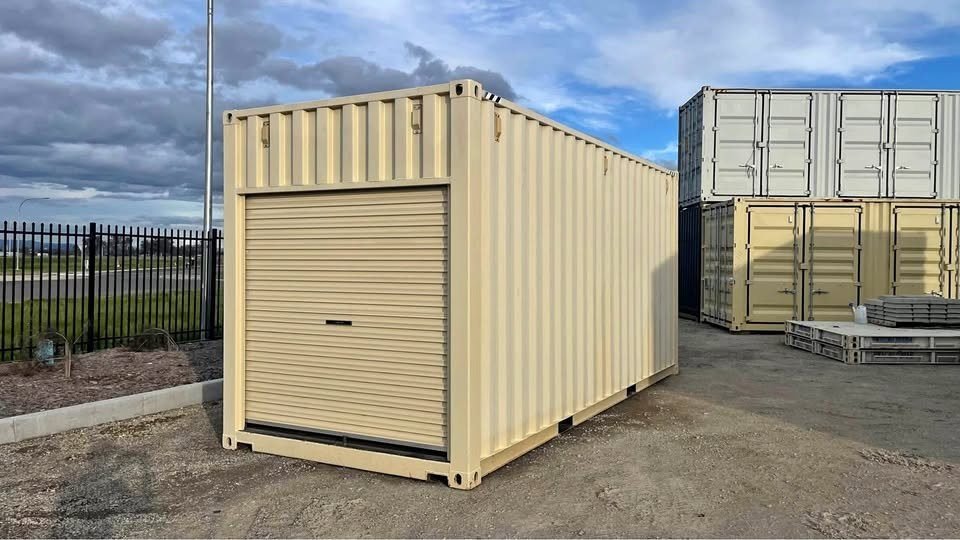
A shipping container garage is the cheapest way to put a secure, weatherproof, lockable structure over a vehicle without pouring a foundation or applying to build a garage. A 40ft container takes two cars end to end. A 20ft takes one, with room left for a bench.
The whole project turns on one decision that most buyers get wrong: the door. A container's standard cargo doors are about 7'8" wide, and the opening is not where you want it for a garage. This guide covers door options, layouts, whether to buy one container or two, and what the finished thing actually costs.
Will a Car Actually Fit?
Yes, with room to spare on width for most vehicles — and the constraint you need to check is the door aperture rather than the interior.
| 20ft standard | 20ft high cube | 40ft standard | 40ft high cube | |
|---|---|---|---|---|
| Internal length | 19'4" | 19'4" | 39'5" | 39'5" |
| Internal width | 7'8" | 7'8" | 7'8" | 7'8" |
| Internal height | 7'10" | 8'10" | 7'10" | 8'10" |
| Cargo door opening | 7'8" × 7'6" | 7'8" × 8'6" | 7'8" × 7'6" | 7'8" × 8'6" |
| Vehicles | 1 compact/mid-size | 1, plus roof clearance | 2 end to end | 2, plus roof clearance |
A typical mid-size car is around 6 feet wide excluding mirrors, so it passes a 7'8" aperture. The problems appear with full-size pickups, anything with wide mirrors that do not fold, and vehicles over about 7 feet tall — which is where high cube earns its money. If you are storing a van, a truck with a rack, or anything on a trailer, measure the actual vehicle at its widest and tallest points before choosing.
What does not fit comfortably in an 8-foot-wide box is a car plus a person opening the door. Getting in and out is tight. That is a strong argument for a 40ft rather than two 20ft units if you park daily, and an equally strong argument for treating a container garage as vehicle storage rather than a daily-driver parking space.
Door Options: The Decision That Matters
1. Standard cargo doors (end opening)
The doors you already have. Free, secure, and awkward: they swing through 270 degrees and need about 8 feet of clear space in front of the container. They are also at the end, so you approach along the container's length — which means your driveway needs to line up with the box.
Good for: occasional-access vehicle storage, boats, project cars, motorcycles.
2. Roll-up shutter door in the end
Replaces or supplements the cargo doors with a roller shutter. No swing space needed, opens quickly, and looks like a garage. The header takes some height, so a high cube helps. A 20ft high cube with roll-up door is exactly this configuration.
Good for: regular access on a tight site.
3. Roll-up shutter in a side wall
This is the configuration most people actually want and few consider. Cutting a wide roller shutter into a long side turns the container from a tunnel into a bay: you drive in perpendicular, park across the width, and the whole length is open to you. On a 40ft you can have several bays.
Options like the matte black 20ft with a 12ft side opening, the 20ft with dual side roll-up doors, and the 40ft with three roll-up side doors show what is possible. Note that side openings are the configuration that most often needs structural reinforcement, because you are removing a substantial section of a load-bearing wall.
4. Double doors at both ends
A double door container has cargo doors at both ends, so you can drive in one end and out the other. It is the drive-through configuration and it also makes long items far easier to load. Tunnel-style units in the tunnel containers range do the same thing.
5. Smaller compact units
For motorcycles, ATVs, ride-on mowers and garden machinery, a full-size container is overkill. A 16ft roll-up door container gives easy access on a much smaller footprint.
| Door option | Swing space needed | Access | Reinforcement needed |
|---|---|---|---|
| Standard cargo doors | ~8 ft | Along the length | None |
| End roll-up shutter | None | Along the length | Minimal |
| Side roll-up shutter | None | Across the width | Yes |
| Double doors, both ends | ~8 ft each end | Drive-through | None |
| Personnel door plus shutter | ~3 ft | Separate walk-in access | Minor |
Whatever you choose, add a personnel door. Opening a full shutter to fetch a screwdriver gets tiresome, and in winter it dumps all the heat.
One Container or Two?
Two 20ft or 40ft containers set parallel with a gap between them, roofed over, is a classic and very effective garage design. You get:
- Two enclosed, secure bays for storage and tools.
- A wide covered central bay between them, as wide as you choose, with no width limit from the container.
- Structure to hang a roof from, without needing posts.
The central span is a real roof structure and needs designing — that is a beam spanning between two containers, carrying snow load in northern states. Have it engineered. But the containers themselves are doing what they are good at: holding weight at the corners and providing secure enclosure.
The alternative — a single 40ft — is cheaper, simpler, arrives in one delivery, and gives you a long narrow space. Both are valid; the parallel arrangement is better if you actually want to work on the vehicle.
Floor, Height and Working Space
Three practical points that decide whether the space is pleasant to use:
- Height. Buy high cube. A 7'10" ceiling over a car leaves no room for a light fitting, a hoist, or a roof rack. 8'10" changes the space entirely. Browse the high cube listings for what is available.
- Floor. Container plywood is treated against insects and decay as a condition of international movement, and it handles vehicle weight without difficulty — carrier specification data puts the design case at a forklift axle load in the order of 12,000 lb. What it does not handle well is oil, solvent and long-term damp. Seal it, overlay it with ply and epoxy, or lay steel plate under the wheels.
- Ventilation. A sealed steel box with a warm car in it produces condensation, and condensation on a stored vehicle is how paint fails. Vents high and low at opposite ends are the minimum; a stored classic wants a dehumidifier or a car cover with airflow.
Insulation: Do You Need It?
For pure vehicle storage, no — ventilation matters far more than insulation. For a garage you will actually work in, yes, and the reasoning is in the insulation guide. The half-measure worth knowing about: insulating only the roof kills most of the summer heat and most of the condensation for a fraction of the cost of a full job.
Site and Delivery
A garage has to be somewhere a car can reach, which usually means it is also somewhere a truck can reach — but check the numbers anyway. Allow the container length plus roughly 40 feet of straight run, about 12 feet of width and 15 feet of overhead clearance. Then think about the approach for the vehicle: you need room to line up with the door, and if the door is in a side wall you need a turning area in front of it.
Set the container level and drained on a proper pad. A garage floor that has settled at one corner is a garage floor that collects water at that corner. See the notes on setting a container level.
Permits
An unmodified storage container in a rear yard is treated very differently from a structure with a shutter door cut into it that a car drives into. Cutting openings brings the unit under the building code in most jurisdictions, and a two-container roofed arrangement is unambiguously a structure. Read the zoning and permitting walkthrough, then call your planning department with the specifics — footprint, height, setbacks, and whether it is permanent.
Budgeting the Project
| Item | Notes |
|---|---|
| Container | Used 40ft from around $1,300–$2,250 depending on grade; roll-up-door units from roughly $2,400 |
| Delivery | Flat $500 to any address in the 50 states |
| Door modification | Cheaper specified at purchase than retrofitted; side openings need reinforcement |
| Gravel pad | Crushed stone plus blocks under the corners |
| Vents and lighting | Modest, and worth doing at the outset |
| Permit | Set locally |
Buying a unit that already has the door you want is almost always cheaper than cutting one later, because a retrofit means a second mobilization, on-site welding and a paint repair. Browse the 40ft container listings and the modified container range for units with doors already fitted, and tell us the configuration you want if you want a specific configuration.
Frequently Asked Questions
Will a car fit in a shipping container?
Yes. A container is 7'8" wide internally with a cargo door opening about 7'8" wide, which clears a typical mid-size car of roughly 6 feet. A 20ft holds one vehicle and a 40ft holds two end to end. Check full-size pickups, vans and anything over 7 feet tall against the door aperture before buying.
What size container do I need for a garage?
A 40ft high cube for two vehicles or for one vehicle plus a working area; a 20ft high cube for a single car, motorcycle collection or garden machinery. Choose high cube in either case — the extra foot of height is what makes room for lighting, a roof rack or a hoist.
Can you put a roll-up door in a shipping container?
Yes, in the end wall or in a side wall. End installations are straightforward. Side installations turn the container into a drive-in bay and are the configuration most people actually want, but they remove a section of load-bearing wall and need structural reinforcement, so specify them at purchase rather than cutting later.
Do I need a permit for a container garage?
Usually. Cutting a door opening brings the unit under the building code in most jurisdictions, and a two-container roofed arrangement is unambiguously a structure. Unmodified storage in a rear yard is treated far more leniently. Confirm footprint, height and setback rules with your planning department before ordering.
How do I stop condensation in a container garage?
Ventilate before you insulate. Fit vents high and low at opposite ends so warm moist air can escape, keep the container off the soil on a drained pad, and insulate the roof if you can — the ceiling is where condensation forms and drips onto the vehicle. A cover that allows airflow beats a sealed one for stored vehicles.