
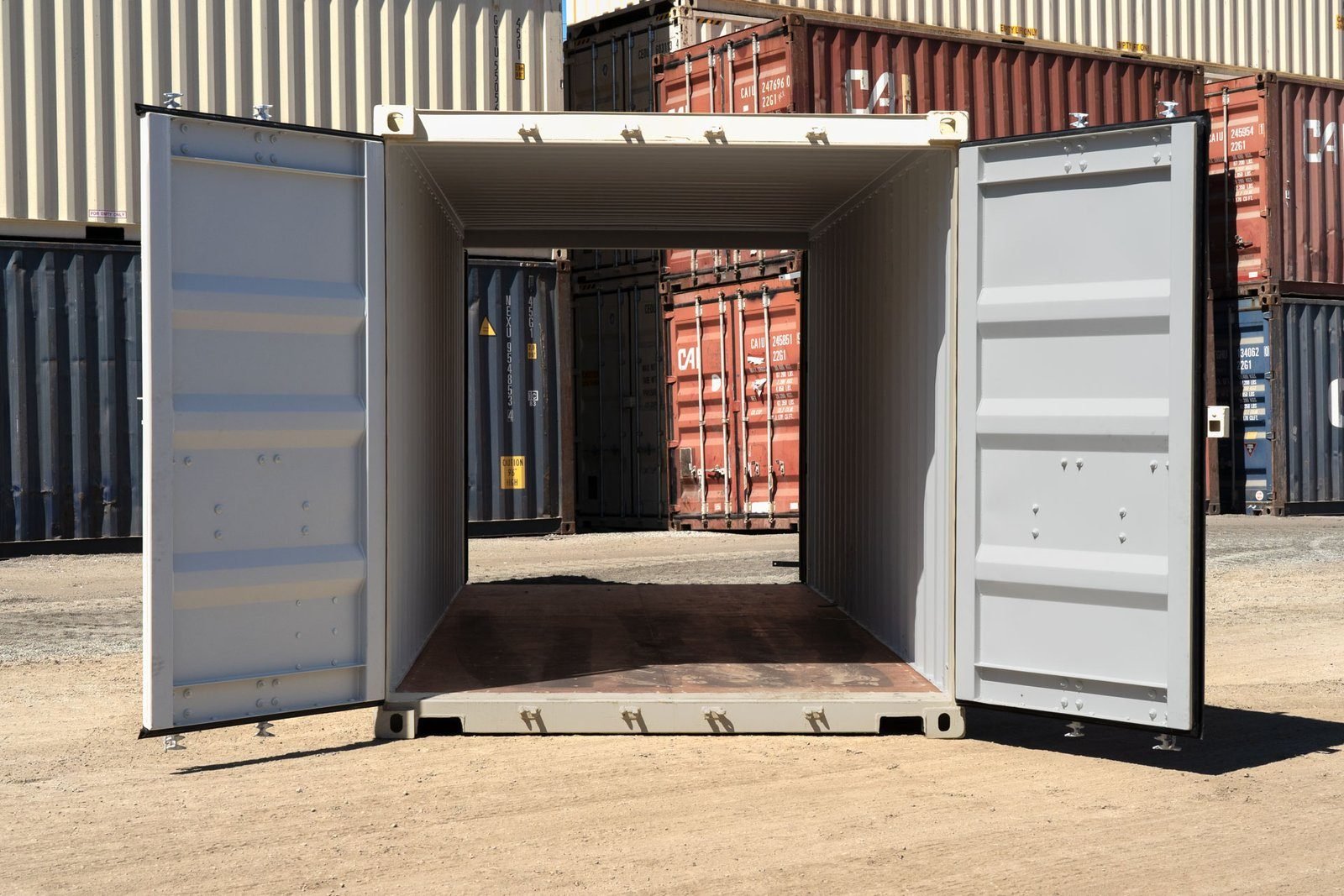
Container buying has a vocabulary problem. The same steel box is a conex, a sea can, a cargo container, a shipping container and a storage container depending on who is talking, and terms like CW, WWT, HC, tare and CSC get used on listings without explanation. This glossary defines every term you are likely to meet, grouped by what it describes, so you can read a listing and know exactly what you are being offered.
Names for the Container Itself
Shipping container
The general term for a standardized steel freight container built to ISO dimensions. Covers everything from a 10ft box to a 53ft high cube.
Conex / conex box
From Container Express, the US military transport containers that predated modern ISO containers. The name stuck and remains common vernacular, particularly in the South and Midwest, where “conex” is often the default word for any shipping container. When someone asks for a conex box, they mean a standard steel shipping container.
Sea can
Regional slang, most common in Canada and the northern US, for a used ocean container. Same object.
Cargo container / freight container / ISO container
Interchangeable formal terms. “ISO container” emphasises conformity to the international standards that fix the dimensions and ratings.
Storage container / portable storage
Describes the use rather than the object. Usually a container that has left ocean service and is sold for static storage. Browse the storage container listings for units sold in this role.
Dry van / general purpose (GP)
A standard closed container with doors at one end — the default type. Distinguished from reefers, open tops, flat racks and tanks.
Standards and Documentation
ISO 668
The international standard that sets the classification, external dimensions and ratings of series 1 freight containers. It is the reason an 8-foot-wide container built anywhere stacks and locks anywhere. Type codes such as 1AA, 1AAA, 1CC and 1EEE come from this standard and encode length and height.
ISO 1496-1
The specification and testing standard for general-purpose freight containers. Among other things it sets the stacking test force at 3,392 kN per container — derived from eight fully rated containers stacked on one with a dynamic factor applied — and it sets minimum door aperture sizes: 2,261 mm high by 2,286 mm wide for 1AA/1BB/1CC types, and 2,134 mm by 2,286 mm for 1A/1B/1C/1D types.
ISO 6346
The standard governing container identification — the owner code, equipment category identifier, serial number and check digit painted on every box, plus the size and type codes.
CSC / CSC plate
The International Convention for Safe Containers, adopted in 1972, and the metal data plate that evidences compliance. The plate must be permanent, non-corrosive and fireproof, at least 200 mm by 100 mm, and must carry the month and year of manufacture, the maximum gross weight in kilograms and pounds, and the stacking and racking test load values. Under the periodic examination scheme, a container must be examined before the fifth anniversary of manufacture and thereafter at intervals not exceeding 30 months, with the next examination date shown.
ACEP
Approved Continuous Examination Programme — the alternative to periodic examination, under which an operator inspects containers on a continuous approved schedule rather than at fixed intervals.
IBC 3115
The section of the International Building Code, introduced in the 2021 edition, that addresses intermodal shipping containers repurposed as buildings. It covers retention of the container's data plate, floor decay and termite protection, under-floor ventilation, roof assemblies, and structural design referencing ISO 1496-1. Relevant to any occupied container conversion — see our guide to permitting a container structure.
Condition Grades
One-trip / new
Built recently and shipped with cargo exactly once before sale. Factory paint, clean floor, unworn gaskets. The standard base for conversions. See the new container listings.
Multi-trip
A young container with more than one voyage behind it. Close to one-trip condition without the premium.
Cargo-worthy (CW)
Surveyed as structurally sound and fit for international carriage. Cosmetic rust and dents are normal. Where a current CSC plate is fitted, the unit remains within the examination scheme.
Wind & watertight (WWT)
Dry and sealed against weather, but not offered as certified for ocean carriage. The value grade for static storage.
As-is / storage class
Sold in the condition described, with no representation beyond that description. Cheapest steel per square foot; read the listing carefully.
Refurbished
Repaired and repainted before sale. Appearance closer to new at a used price.
Full definitions of each grade, with what to expect physically, are in the container grades guide. Compare grades side by side in the used container listings.
Sizes and Dimensions
| Term | Meaning |
|---|---|
| Standard height | 8'6" external, about 7'10" internal |
| High cube (HC) | 9'6" external, about 8'10" internal — a foot taller |
| TEU | Twenty-foot Equivalent Unit; the industry's counting unit. A 40ft container is 2 TEU |
| FEU | Forty-foot Equivalent Unit |
| Nominal length | The advertised length — 20ft, 40ft — which is external, not internal |
| Pallet-wide | A slightly wider container built around European pallet dimensions; uncommon in the US |
Full dimension tables for every size are in the dimensions guide and the full specifications reference. High cube stock is listed under high cube containers.
Weights
Tare weight
The weight of the empty container. Roughly 4,850 lb for a 20ft standard and 8,200 lb for a 40ft standard. Flooring affects it noticeably: published carrier data shows a steel-floored 40ft high cube at about 9,480 lb against 8,488 lb for the wooden-floored version.
Payload
The maximum weight of cargo the container is rated to carry.
Maximum gross weight (MGW)
Tare plus payload — the most the loaded container may weigh. Commonly 32,500 kg (71,650 lb) on ISO general-purpose units, and stamped on the CSC plate.
Racking and stacking test loads
The forces the container was tested to withstand, also recorded on the CSC plate. Stacking relates to vertical load from containers above; racking to lateral forces.
Types and Configurations
Reefer
A refrigerated container with an integral refrigeration unit and insulated panels. Sold as working or non-working. See the refrigerated container guide and the guide to non-working reefers.
Open top
A container with a removable tarpaulin or hard roof instead of a fixed one, for top loading of tall or crane-loaded cargo. A 20ft open top cargo-worthy unit is the common size; see the open top containers category.
Flat rack
A container base with collapsible or fixed end frames and no side walls, for oversized cargo. A 20ft flat rack is the standard configuration.
Double door / tunnel
Doors at both ends, allowing drive-through access and easier loading of long items. See double door units and tunnel (double-ended) containers.
Side opening / open side
Doors along a long side rather than at the end, turning the container into a wide bay. Requires structural reinforcement where a large aperture is cut.
Roll-up door
A roller shutter in place of, or in addition to, swing doors. No swing space required.
Flat pack
A unit that ships folded or in panels and assembles on site — useful where a rigid container cannot physically reach the position. See flat pack containers.
Bunded container
A container with a sealed containment sump in the floor for storing liquids or hazardous goods.
Anti-vandal
A unit specified for security — reinforced doors, shrouded locks, protected openings.
Parts of a Container
| Part | What it does |
|---|---|
| Corner casting | The cast steel fitting at each of the eight corners. Carries the entire load and takes the twist locks |
| Corner post | The vertical structural member between top and bottom corner castings |
| Bottom rail | The horizontal member along the base of each side; the first place structural rust appears |
| Cross-member | Transverse steel beams under the floor supporting the plywood |
| Corrugation | The profiled sheet forming the walls; adds stiffness in the vertical direction |
| Cam and rod gear | The vertical locking rods and cams that seal and secure the doors |
| Lock box | A welded steel shroud over the padlock to defeat bolt croppers |
| Twist lock | The fitting that locks into corner castings to secure containers to each other or to a chassis |
| T-bar / T-decking | Aluminium floor profile in reefers that lets air circulate beneath cargo |
| Vent | Louvred openings near the top of the side walls for passive airflow |
Materials
Weathering steel / COR-TEN
The alloy family used for container walls. COR-TEN is a U.S. Steel trade name; equivalent standards include ASTM A588, A242 and A606, with A606 Type 4 carrying a minimum corrosion-resistance index of 6.0 under ASTM G101. The steel forms a tight surface oxide that slows further corrosion rather than flaking, which is why heavily rusted-looking containers are often structurally fine.
Marine plywood floor
The container floor, typically treated against insects and decay as a condition of international movement.
Buying and Delivery Terms
Tilt-bed / roll-off delivery
The standard delivery method: the truck bed tilts and the container slides off as the truck creeps forward. Needs the container's length plus roughly 40 feet of straight clearance.
Ground-level office (GLO)
A container converted to an office that sits at ground level, as distinct from a towed office trailer on wheels. See the container office range.
Depot
A yard where containers are stored, inspected and repaired.
Pre-trip inspection (PTI)
The standard self-test that exercises a reefer's refrigeration circuit before use. Ask whether a used working reefer has passed one.
Putting It to Use
The vocabulary matters because listings are written in it. When you can read “40ft HC CW, CSC plated, tare 8,488 lb, double door” and picture exactly what is arriving, you can compare offers properly. Browse our containers for sale or the ISO container listings and the terminology should now read straightforwardly. Anything unclear on a listing, ask our team — we would rather explain it than have you buy the wrong box.
Frequently Asked Questions
What is a conex box?
Conex is short for Container Express, the US military transport containers that predated modern ISO containers, and the name stuck as everyday vernacular for any steel shipping container. It is especially common in the South and Midwest. Someone asking for a conex box means a standard shipping container.
What does CW mean on a container listing?
Cargo-worthy: the container has been surveyed as structurally sound and fit for international carriage. Cosmetic surface rust and dents are normal at this grade. Where a current CSC plate is fitted, the unit also remains within the periodic examination scheme required for cargo service.
What is a CSC plate and why does it matter?
It is the metal data plate evidencing compliance with the International Convention for Safe Containers. It must be permanent, non-corrosive and fireproof, at least 200 mm by 100 mm, and must show the month and year of manufacture, maximum gross weight in kilograms and pounds, and the stacking and racking test values — the only dated, verifiable data on the container.
What does tare weight mean?
The weight of the empty container itself, before any cargo. Roughly 4,850 lb for a 20ft standard and 8,200 lb for a 40ft standard, though flooring changes it — a steel-floored 40ft high cube is published at about 9,480 lb against 8,488 lb for the wooden-floored equivalent. Tare plus payload gives maximum gross weight.
What is the difference between a high cube and a standard container?
Height only. A high cube is 9'6" externally against 8'6" for a standard container, giving about 8'10" of internal height instead of 7'10". Length, width and footprint are identical, so a high cube gives more cubic capacity on the same ground area.