
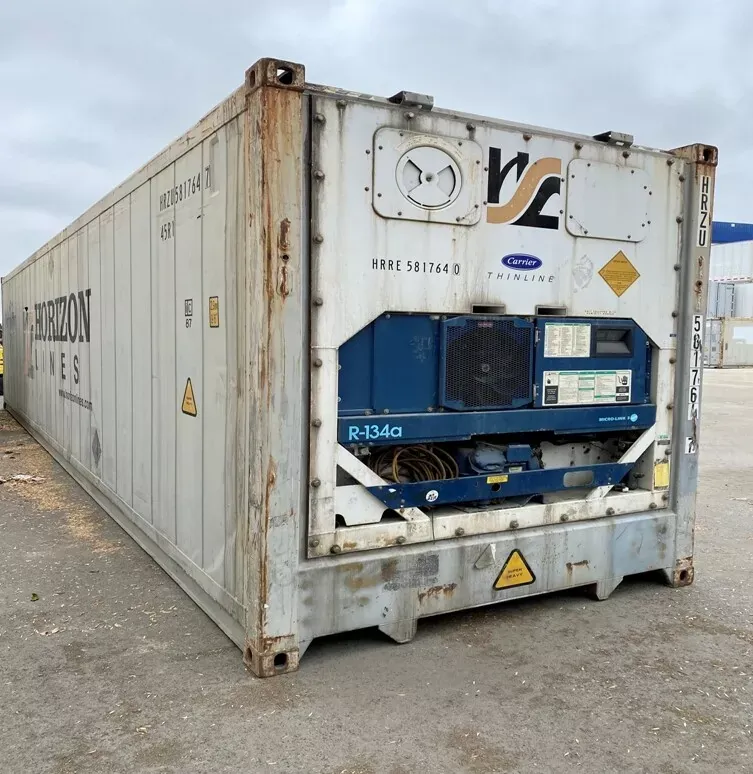
A non-working reefer container is a refrigerated shipping container whose refrigeration machinery no longer runs. The insulated shell — foam sandwiched between steel skins on all six faces, aluminium T-bar decking, heavy-duty gaskets — is completely unaffected. What you get is the most heavily insulated steel box on the market at roughly half the price of the working equivalent.
For a large number of buyers, that is a better product than the working unit they came looking for. This guide explains what a non-working reefer actually is, what it is genuinely good for, what it is not, and how to buy one without disappointment.
What Makes a Reefer Different from a Dry Container
A standard dry container is a single skin of corrugated weathering steel. Thermally it does almost nothing: the interior tracks the exterior temperature with a lag, and every interior surface is a potential condensation point.
A reefer is built as an insulated envelope from the outset:
- Insulated panels on walls, roof and floor — typically foam bonded between inner and outer steel skins, engineered to hold a setpoint against tropical ambient temperatures.
- Aluminium T-bar decking on the floor, designed so air circulates beneath the load.
- Heavy door gaskets with a compression seal far beyond a standard dry container's.
- A stainless or aluminium interior lining — smooth, washable, and far better suited to food, laboratory or clean-storage use than bare corrugated steel.
- A vapour-tight construction, because a refrigerated envelope that lets moisture into the insulation fails quickly.
None of that depends on the compressor working. When the machinery fails, the envelope remains exactly what it was.
Working vs Non-Working: The Price Case
The comparison from our own catalog:
| Unit | Machinery | Catalog price |
|---|---|---|
| 40ft reefer container | Non-working | ~$3,100 |
| 40ft HC reefer, wind & watertight | Non-working | ~$5,900 |
| 40ft HC refrigerated container | Working | ~$6,700 |
| 40ft refrigerated container | Working | ~$6,695–$8,500 |
| 40ft freezer container, low temperature | Working | ~$17,650 |
The gap between a 40ft reefer sold non-working and a comparable working unit is in the order of $3,000–$4,000. If you are never going to switch the machinery on, that is $3,000–$4,000 spent on a compressor as a decorative feature.
Compare it the other way, against dry containers. A cargo-worthy 40ft dry container is around $2,150. For roughly $950 more, a non-working reefer gives you a fully insulated, lined, vapour-sealed envelope — a specification that would cost several times that to build into a dry container on site, and would still not match it.
What a Non-Working Reefer Is Genuinely Good For
Temperature-stable dry storage
The obvious one. Anything that suffers from heat swings — paint, adhesives, resins, electronics, seed stock, documents, musical instruments, wine — sits far more happily in an insulated envelope. The container will still follow the outside temperature over days, but it will not track it hour by hour the way an uninsulated dry container does, and the peaks are dramatically flattened.
A base for your own climate control
This is the strongest use case. Rather than buying refrigeration machinery designed for ocean transport, sized for cargo you do not have, and requiring a three-phase supply you may not have either, you fit a mini-split heat pump on a single-phase domestic circuit. You get heating and cooling, modern efficiency, quiet operation and serviceable parts — inside an envelope engineered to hold temperature.
For a workshop, a home gym, a server or equipment room, or a garden studio, this is usually the cheapest route to a genuinely conditioned steel building.
Workshops and occupied spaces
The lined interior is a real advantage. A dry container needs battens, insulation, a vapour barrier and lining before it is a comfortable space to work in; a reefer arrives with all of that built in and bonded. A 40ft HC non-working reefer gives you a high-cube-height insulated room straight off the truck.
Food-adjacent and clean storage
The interior lining is smooth, washable and designed for food service. For dry goods storage, packaging, or anything where a corrugated steel wall is hard to clean, that surface is worth having on its own.
Growing and controlled environments
An insulated, sealed, lightproof envelope with a drained floor is a useful starting point for controlled-environment growing. Add your own lighting, ventilation and climate control to a specification you choose.
What It Is Not Good For
Being straight about the limits:
- It is not a refrigerator. Without working machinery or a substitute system, it will not hold a cold setpoint. It slows temperature change; it does not create cold.
- It is not repairable at a sensible price, usually. Reefer machinery repair means specialist refrigeration labour, and older units may use refrigerants that are now costly or restricted to service. Assume the machinery stays off.
- The machinery end still takes up space. The compressor housing occupies one end wall whether or not it runs, so internal length is shorter than the nominal size suggests. Work from the listing's internal dimensions.
- It is heavier. Reefers weigh more than dry containers of the same size, which matters for the delivery pad and for any future relocation.
- Ventilation is still needed. A sealed insulated envelope with no airflow and a moisture source inside will still accumulate humidity. Fit vents or run a dehumidifier if the space is occupied.
Non-Working Reefer vs the Alternatives
| Non-working reefer | Dry container, insulated on site | Working reefer | |
|---|---|---|---|
| Typical purchase cost (40ft) | ~$3,100–$5,900 | ~$2,150 plus insulation work | ~$6,700–$17,650 |
| Insulation quality | Factory envelope, all six faces | Depends entirely on workmanship | Factory envelope |
| Interior finish | Lined and washable | Whatever you build | Lined and washable |
| Thermal bridging | Minimal, bonded panels | Common at battens and posts | Minimal |
| Site labour required | None | Substantial | None |
| Holds a cold setpoint | No | No | Yes |
| Power required | Only what you add | Only what you add | Three-phase, typically |
| Internal length | Reduced by machinery end | Full | Reduced |
What to Check Before Buying
The inspection is different from a working reefer, because you are buying an envelope rather than a machine.
- Panel integrity. Bulges, soft spots or crushed sections mean the foam core is damaged or water-saturated. Saturated insulation is heavy, useless and does not dry out. Press and look along the walls in raking light.
- Interior lining. Punctures and tears let moisture into the core. Small repairs are fine; widespread damage is not.
- Door gaskets. Reefer gaskets are the best in the container world when intact and the worst thing to discover perished. Check they are continuous and pliable.
- Floor and T-decking. Damaged decking is cosmetic if you are laying a floor over it, structural if you are not. Check the drains are clear.
- The shell exterior. Same checks as any used container — bottom rails, corner posts, roof dents. The inspection checklist applies.
- Whether the machinery can be removed. If you want the extra length, ask. Removing a unit leaves an aperture that must be panelled and sealed properly.
- What “non-working” means on the listing. Not running is different from not present. Confirm which you are buying.
Sizes and Options
Non-working stock turns up across the size range. Our refrigerated container category lists working and non-working units separately, and the broader reefers for sale listings show the full range. Smaller alternatives such as a used 20ft reefer suit sites that cannot take a 40ft delivery, while a 20ft mobile cold storage unit or a Stoughton 40ft unit are worth comparing if you want the option of running machinery later.
If you do need active refrigeration after all, the deep-freeze reefers cover the low-temperature end, and the reefer buying guide covers power requirements, running costs and what to inspect on a working unit.
Delivery and Siting
Delivery is the same flat $500 to any address in the 50 states, scheduled 5–10 business days after payment clears, on a tilt-bed truck. Allow the container's length plus roughly 40 feet of straight clearance, about 12 feet of width and 15 feet overhead.
Two reefer-specific points: leave clearance at the machinery end even if the machinery is dead, because you may want access to remove or panel over it later; and pay attention to drainage under the unit, since a container that is going to be conditioned will produce condensate once you fit your own system.
Is It the Right Buy for You?
Ask one question: do you need the container to make cold, or do you need it to hold a temperature? If you need it to make cold and can supply three-phase power, buy working. If you need an insulated, lined, sealed steel room — and especially if you intend to fit your own heating and cooling — a non-working reefer is the better product and the cheaper one.
Not sure which side of that line you fall on? Describe the job to our team and we will tell you plainly which unit to buy.
Frequently Asked Questions
What is a non-working reefer container?
It is a refrigerated shipping container whose refrigeration machinery no longer operates. The insulated panel construction, lined interior, aluminium T-bar floor and heavy door gaskets are unaffected, so what you buy is a fully insulated steel envelope without the working compressor — typically at roughly half the price of the equivalent working unit.
Can a non-working reefer be repaired?
Sometimes, but it is rarely economic. Reefer machinery repair requires specialist refrigeration labour, and older units may run refrigerants that are now expensive or restricted to service. Buy a non-working reefer on the assumption that the machinery stays off, and treat any successful repair as a bonus.
Is a non-working reefer better than insulating a dry container?
For most buyers, yes. The factory envelope is bonded to the structure with minimal thermal bridging and arrives with a washable lining already fitted, which is difficult and expensive to match with site-applied insulation. It also requires no labour, no vapour-barrier detailing and no lining work.
Will a non-working reefer stay cool without power?
It will resist temperature change far better than a dry container, flattening daily peaks considerably, but it will not create or hold a cold setpoint. Over days it follows the ambient temperature. If you need a genuine cold room, fit your own cooling system or buy a working unit.
How much smaller is the interior of a reefer?
The refrigeration machinery occupies one end wall, so internal length is noticeably shorter than a dry container of the same nominal size — and that remains true whether or not the machinery runs. Always work from the internal dimensions stated on the individual listing when planning a layout.