
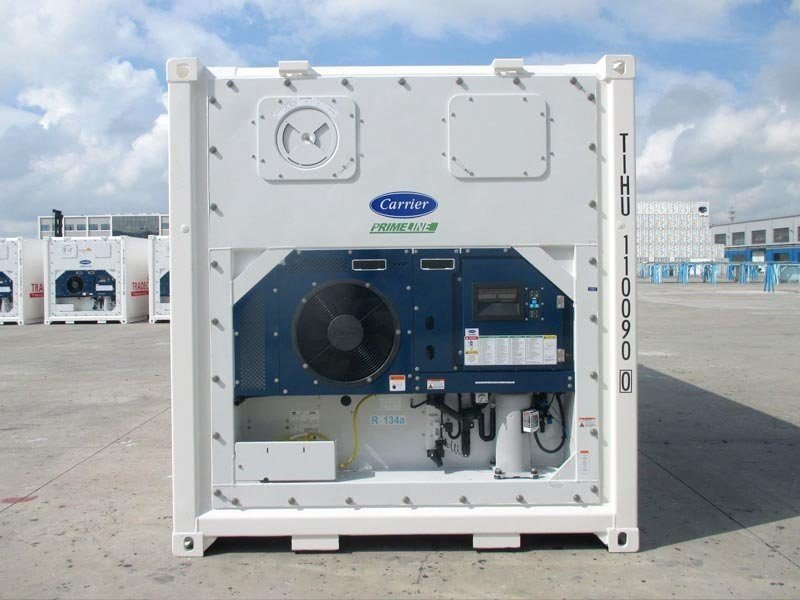
A refrigerated shipping container — a “reefer” — is a standard steel container with an integrated refrigeration unit and insulated walls, floor and ceiling. It turns a shipping container into a walk-in cooler or freezer you can put anywhere you have suitable power. Here's what to know before you buy one, including the electrical question that derails more reefer purchases than everything else combined.
How a Reefer Is Built
The refrigeration machinery sits in one end wall, so a reefer's usable interior is shorter than a dry container of the same nominal length. The walls are insulated foam sandwiched between steel skins, and the floor is T-shaped aluminium decking that lets cold air circulate underneath the cargo and back to the unit. That airflow design is why a reefer holds temperature far better than an insulated box with a domestic air conditioner bolted on.
Because the machinery occupies real estate at one end, always check the internal dimensions on the listing rather than assuming the standard figures for that nominal size.
Temperature Range
Most integral reefer units hold a setpoint anywhere from roughly +77°F down to about -22°F (+25°C to -30°C), which covers chilled produce, dairy, floristry, pharmaceuticals and hard-frozen storage. Deep-freeze and blast-chill duties are outside what a standard transport reefer is designed to do. Some units are specified for lower temperatures — our -40°F freezer containers are listed separately for exactly that reason. If you need a specific setpoint, tell us and we will confirm honestly whether a given unit will hold it.
Power Requirements — Check This First
This is where most reefer purchases go wrong. A standard integral reefer unit is built for three-phase power, typically in the 380–460V range, and it draws meaningfully more current on start-up than it does while running. A domestic single-phase supply will not run one.
- Have three-phase on site? You need the right receptacle and a circuit rated for the unit — have an electrician confirm before delivery day, not after.
- No three-phase? A diesel generator set can power the unit, which is also how reefers run in transit. Budget for the genset, fuel and servicing.
- Smaller and converted units are sometimes built around single-phase equipment. Never assume — confirm the electrical specification for the specific unit you are buying.
| Power situation | Workable? | What it means in practice |
|---|---|---|
| Three-phase 380–460V on site | Yes | Correct receptacle and a suitably rated circuit; electrician to confirm |
| Three-phase available nearby | Usually | Cost of running a supply to the container position |
| Single-phase domestic only | Not for a standard reefer | Consider a genset, a single-phase-specified unit, or a non-working shell |
| No power at all | No | Genset, or buy a non-working reefer as insulated dry storage |
Working vs. Non-Working Reefers
A working reefer has functioning machinery and is priced accordingly. A non-working reefer has the same insulated shell but a unit that no longer runs — and it is often the smarter buy. If you want a heavily insulated, wind- and watertight store for a workshop, a dry goods room, or a space you will heat and cool your own way, a non-working reefer gives you all that insulation without paying for refrigeration you will never switch on.
The price gap is substantial: a non-working 40ft reefer lists at around $3,100 against roughly $6,700 for a comparable working 40ft high cube unit. We list working and non-working units separately and say which is which on every listing. The full argument is in the non-working reefer guide.
Sizes and What They Suit
| Size | Typical use | Example unit |
|---|---|---|
| 10ft | Small kitchens, florists, event catering, farm shops | 10ft fridge-freezer unit |
| 20ft | Restaurants, breweries, growers, small distributors | 20ft refrigerated container |
| 30ft | Mid-volume cold storage where a 40ft will not fit | Customized freezer units |
| 40ft | Distribution, processing, seasonal buffer storage | 40ft Daikin reefer |
Small units are easier to site and to power. Large units cost far less per cubic foot of cold space. If a 10ft unit will do the job, a 10ft container footprint is much simpler to accommodate on a constrained site.
What to Check Before You Buy
- Machinery hours and PTI: ask for the running hours and whether the unit has passed a pre-trip inspection, the standard self-test that exercises the whole refrigeration circuit.
- Insulation integrity: punctures, crushed panels or water-saturated foam quietly destroy efficiency. Look for bulged or soft wall panels.
- Door gaskets: a reefer is only as good as its seal. Perished or flattened gaskets are cheap to replace but must be replaced.
- Evaporator and condenser coils: heavy corrosion or bent fins mean reduced capacity and a repair bill.
- Floor drains and T-decking: blocked drains and damaged decking break the airflow the design depends on.
- Refrigerant type: older units may use refrigerants that are now costly or restricted to service.
- Controller and display: confirm the setpoint controller powers up and reads sensibly.
Running Costs
A reefer is a piece of machinery, not just a box. Budget for electricity or diesel, periodic servicing of the refrigeration circuit, and eventual gasket and coil work. Consumption depends heavily on setpoint, ambient temperature, how often the doors open, and whether the unit sits in direct sun — shading a reefer, or simply having it in a light colour, measurably reduces solar gain and therefore run time.
In exchange you get cold storage you own outright, on your own site, with no monthly rental.
Siting and Delivery
Reefers are heavier than dry containers of the same size and need the same tilt-bed access — container length plus roughly 40 feet of straight, firm clearance, about 12 feet of width and 15 feet overhead. Two extra considerations apply:
- Machinery-end clearance. Leave working room at the machinery end for servicing and airflow. A reefer crammed against a wall will run hot.
- Drainage. Reefers produce condensate. Site the unit where that water drains away rather than pooling under the box.
The container delivery walkthrough covers access in detail, and the base preparation guide covers the pad.
Is a Reefer Right for You?
Buy a working reefer if you genuinely need controlled temperature and can supply the power. Buy a non-working one if what you actually want is a heavily insulated container. Buy neither if what you need is a dry, insulated workshop — a lined and insulated dry container from our modified containers may cost less and suit you better.
Browse the full reefer listings or the wider refrigerated containers category to see what is in stock, and speak to our sales team with your setpoint, your power supply and your volume — we will point you at the right unit rather than the more expensive one.
Frequently Asked Questions
What power supply does a refrigerated container need?
Standard integral reefer units are built for three-phase power, typically 380–460V, and draw significantly more current at start-up than while running. A domestic single-phase supply will not run one. Where three-phase is unavailable, a diesel generator set is the usual answer, or a single-phase-specified unit if one is available.
How cold does a reefer container get?
Most integral units hold setpoints from roughly +77°F down to about -22°F, covering chilled and hard-frozen storage. Units specified for lower temperatures are listed separately. Blast chilling and deep-freeze duty are outside what a standard transport reefer is designed to do, so confirm the specification against your required setpoint.
Is a non-working reefer worth buying?
If you want insulation rather than refrigeration, yes. The insulated shell is unaffected by the machinery being out of service, and the price difference is large — roughly $3,100 against about $6,700 for comparable 40ft units in our catalog. It makes a very well-insulated dry store, workshop or conditioned room.
Why is the inside of a reefer shorter than a dry container?
The refrigeration machinery occupies one end wall, taking usable length out of the interior. A 40ft reefer therefore has noticeably less internal length than a 40ft dry container. Always work from the internal dimensions on the listing rather than the standard figures for that nominal size.
What maintenance does a refrigerated container need?
Periodic servicing of the refrigeration circuit, gasket replacement as seals age, coil cleaning, and keeping the floor drains clear so the T-decking airflow is not blocked. Running hours and pre-trip inspection history are the two most useful things to ask about before buying a used working unit.