
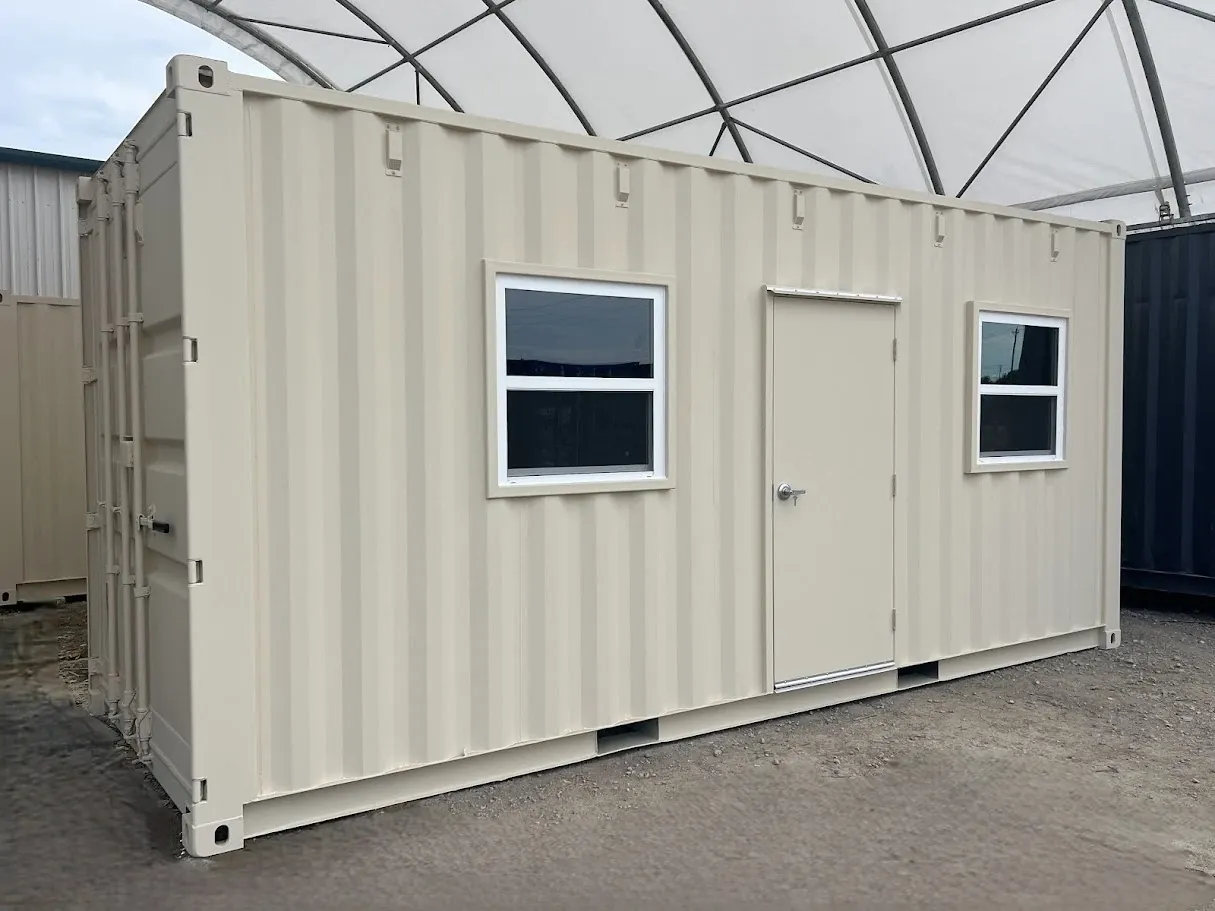
“Do I need a permit for a shipping container?” is the question we're asked most often, and the honest answer is: it depends entirely on where you live. There is no national rule. Permitting is set by your city, county or township, and two neighbouring jurisdictions — sometimes two properties a mile apart — can take opposite views. What follows is a general orientation to help you ask the right questions. It isn't legal advice, and you should confirm with your local authority before you buy.
Two Separate Systems: Zoning and Building Code
People conflate these and then get contradictory answers. They are different departments answering different questions.
- Zoning asks whether a container may be on that parcel, and where. It governs land use: permitted structures, setbacks, accessory-structure rules, screening, and how long a temporary structure may stay.
- Building code asks how the structure must be built if it is one. It governs the physical construction: structure, egress, fire, ventilation, energy and services.
An unmodified storage container often sits entirely inside the zoning conversation and never touches the building code. A container office with windows, power and people inside touches both.
What Usually Triggers a Permit
| Factor | Low permitting risk | High permitting risk |
|---|---|---|
| Duration | Weeks, during a build or a move | Permanent placement |
| Modification | Unmodified box | Cut openings, windows, doors, vents |
| Services | None | Electrical, plumbing, HVAC |
| Occupancy | Storage only | People work or sleep inside |
| Foundation | Gravel and blocks | Poured footings or slab |
| Zone | Industrial, agricultural | Residential |
| Quantity | One unit | Several, or stacked |
Read that table as a risk gradient rather than a rulebook. The further right your project sits on each row, the more likely a permit is required and the more likely it is a full building permit rather than a simple placement approval.
What Often Doesn't Need a Permit
A single container used as unmodified storage, on private property, in an industrial or agricultural zone, frequently needs nothing at all. Agricultural land in particular is often treated leniently, with containers used as farm storage falling under broad accessory or agricultural-use provisions. Construction sites almost always allow containers for the duration of the work.
But “often” is not “always,” and this is the area where confidently written advice on the internet is most likely to be wrong for your address. Verify locally.
Zoning Rules to Ask About
- Setbacks: the minimum distance the container must sit from property lines, buildings and the street.
- Height and size limits: some accessory-structure rules cap footprint or height, which can rule out a high cube or a stacked arrangement.
- Screening and appearance: a few jurisdictions require fencing, landscaping or painting so the unit isn't visible from the road.
- Number of units: one container may be fine where three is not.
- Front-yard placement: commonly prohibited in residential zones even when rear-yard placement is allowed.
- Time limits: many jurisdictions have a temporary-use window measured in weeks or months, after which the placement becomes permanent and is treated differently.
When the Building Code Applies: IBC Section 3115
Once a container becomes a building — occupied, serviced, or structurally altered — there is now a code section written specifically for it. IBC Section 3115, introduced in the 2021 International Building Code, governs intermodal shipping containers repurposed as buildings. It is worth knowing what it covers, because a container project designed with it in mind goes through plan review far more smoothly than one that isn't.
Provisions include:
- 3115.3 — the container must retain its ISO 6346 data plate; removal requires written approval from the building department.
- 3115.4 — decay and termite protection for the plywood floor.
- 3115.5 — under-floor ventilation requirements.
- 3115.6 — roof assemblies in accordance with the roofing chapter.
- 3115.8 — structural design referencing ISO 1496-1 alongside the code's own structural chapter, via either a detailed procedure or a simplified method for single-unit designs.
Design and analysis also reference ICC G5-2019, the Guideline for the Safe Use of ISO Intermodal Shipping Containers. Whether your jurisdiction has adopted the 2021 IBC is itself a local question — code adoption lags publication, sometimes by years. Ask.
None of this replaces a licensed engineer. Any container structure that people will occupy, and any stacked or multi-unit arrangement, should be designed and stamped by an engineer licensed in your state.
Don't Forget the HOA
A homeowners association is a private agreement, entirely separate from city permitting. An HOA can prohibit a container outright on a property where the city would happily approve it, and it does not need a code justification to do so. Check your covenants before you order — this catches people out regularly, and an HOA dispute is not resolved by a permit.
How to Check Your Address in One Phone Call
Call your local planning and zoning department for land use, or the building department for construction, and be specific. Give them:
- Your address and the zoning district if you know it.
- The container size and height — mention if it is a high cube.
- Whether it will be modified in any way.
- Whether anyone will occupy it, and for what.
- How long it will stay.
- Where on the lot you intend to put it, including distances to property lines.
- What it will sit on — gravel and blocks, or a poured foundation.
Ask directly whether a permit is required and, if so, which one. Ask for the answer in writing or by email — a documented reply is worth having if a question ever arises later. If the answer is “probably fine,” press for the code section it is fine under.
Plan Ahead of the Delivery
Sort permitting before your container arrives. A unit that has to be removed or relocated because of a zoning problem means paying for transport twice, and a container already sitting on a lot is a much worse negotiating position than a drawing. Our own returns window is 30 days with buyer-paid return haulage and a 15% restocking fee, so the arithmetic strongly favours checking first.
Matching the Unit to What Your Site Allows
Once you know what your jurisdiction permits, the specification usually follows:
- Storage only, no modification: a plain dry container from the storage container listings keeps you in the simplest regulatory category.
- Working space with power and windows: a purpose-built unit from our container home office units arrives already built as an occupied space, which is far easier to document than a field conversion. A 40ft office with ADA restroom is an example of a unit specified around accessibility from the start.
- Multi-unit or campus arrangements: the modular building units range is designed to be combined.
- Accommodation: cabin units arrive insulated and lined rather than as a bare shell.
- Specialist training or safety uses: units such as the confined-space training container are usually sited on commercial or industrial land where zoning is more permissive.
Not sure which category fits what your planner told you? Talk to our team with the wording they gave you and we will help you translate it into a specification.
Frequently Asked Questions
Do I need a permit for a shipping container on my property?
It depends entirely on your jurisdiction, the zoning of your parcel, and what you plan to do with the container. Unmodified storage on industrial or agricultural land frequently needs nothing; a modified, occupied or permanently sited container in a residential zone very often does. Call your planning and zoning department with your specific address.
Are shipping containers allowed in residential areas?
Sometimes, and the rules are usually written as accessory-structure provisions covering size, height, placement and screening. Front-yard placement is commonly prohibited even where rear-yard placement is allowed, and some jurisdictions require screening or painting. Homeowners associations can prohibit containers regardless of what the city permits.
What building code applies to container structures?
In the US, IBC Section 3115 — introduced in the 2021 International Building Code — addresses intermodal shipping containers repurposed as buildings, covering retention of the data plate, floor decay and termite protection, under-floor ventilation, roof assemblies and structural design referencing ISO 1496-1. Whether your jurisdiction has adopted that edition is a local question.
Does a container on a construction site need a permit?
Construction sites almost always allow containers for the duration of the work, often under the same approval as the construction itself. Time limits are the thing to check: many jurisdictions define a temporary-use window, and a container that outstays it becomes a permanent structure in the eyes of the code.
Can my HOA stop me putting a container on my land?
Yes. A homeowners association operates under a private covenant that is entirely separate from municipal permitting, and it can prohibit containers outright on properties where the city has no objection. Read your covenants before ordering, because a permit does not override them.