
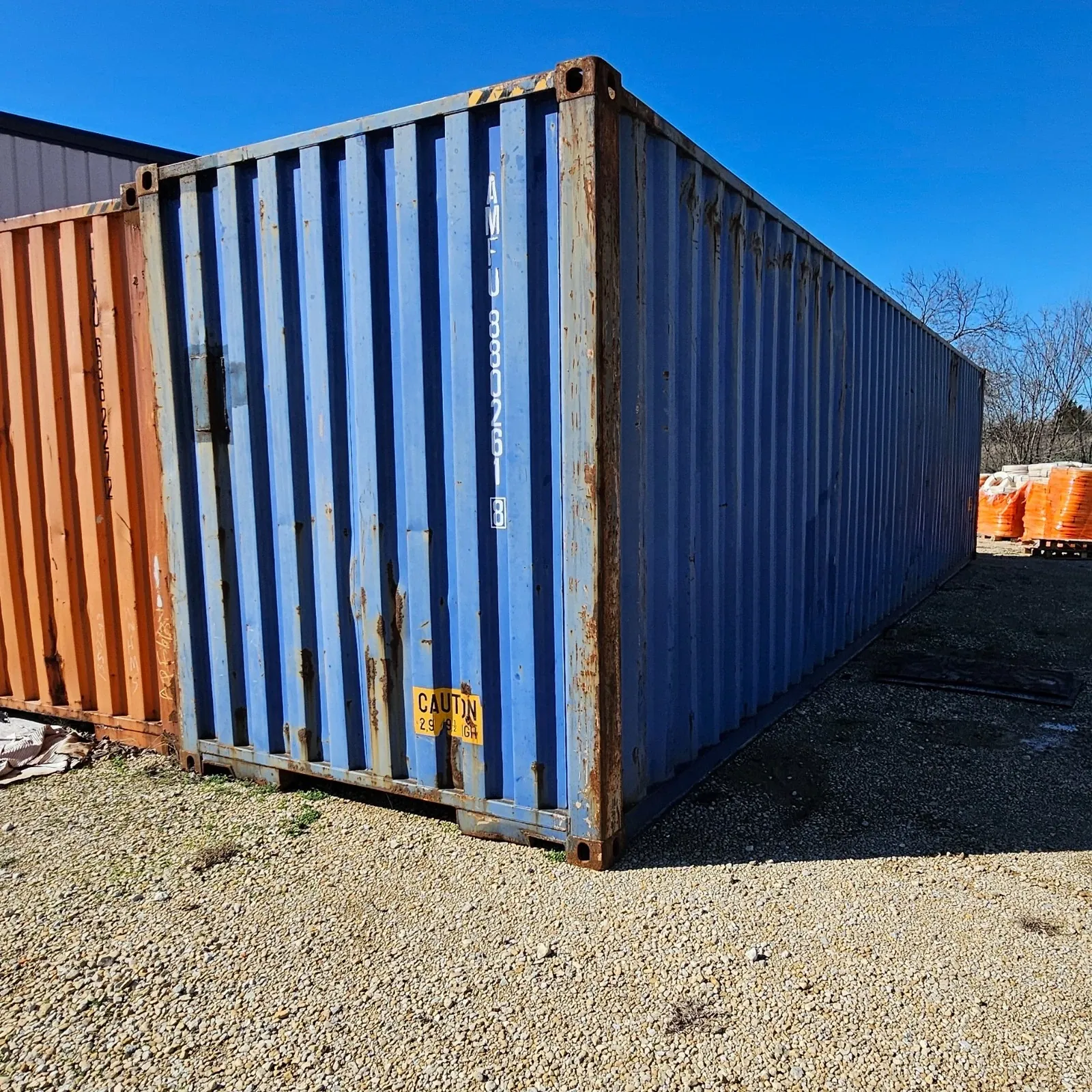
The short version: shipping containers are watertight, not waterproof, and the difference is the reason most people think their container leaks when it doesn't. A sound container keeps rain out. What it cannot do is stop warm, damp air inside from condensing on cold steel — and that water drips from the ceiling exactly like a leak would.
Nearly every “my container is leaking” report turns out to be condensation. This guide covers how to tell the two apart in about five minutes, what watertight actually guarantees, and whether the rust you can see is a problem or just how weathering steel looks.
Watertight vs Waterproof
A container is built to keep ocean weather off cargo for weeks at a time. The doors seal on rubber gaskets compressed by cam-locking gear; the panels are welded, not fastened; the roof sheds water. That is watertight: rain, spray and weather stay outside.
Waterproof would mean no water can appear inside under any circumstances, and no steel box is that, because the water that shows up inside a container usually did not come in from outside. It was already in the air, and the steel simply cooled below the point where the air could hold it.
You will see the grade wind and watertight (WWT) on used stock. That is the industry's term for a unit that is sealed against weather and dry inside, without the cargo certification a cargo-worthy unit carries. It is a statement about sealing, not about condensation.
The Five-Minute Leak Test
Before assuming a seal has failed, do the daylight test. It costs nothing and settles the question.
- Step inside on a bright day, close the doors, and let your eyes adjust for a couple of minutes.
- Look along the roof line, the door seals, the corner posts and the seams.
- Any daylight you can see is a hole. No daylight means the shell is sealed, and whatever water you found came from inside the air, not through the steel.
Then check where the water actually appears. The pattern tells you which problem you have:
| What you see | Almost certainly |
|---|---|
| Even film or droplets across the whole ceiling, worst on cold mornings | Condensation |
| Water in one spot, directly under a visible dent or seam | A genuine leak |
| Damp along the door end after rain and wind | Perished or misaligned door gaskets |
| Damp rising at floor level around the edges | Ground water — the container is sitting too low or in a puddle |
| Rust streaks inside below a roof dent | Ponding above, working through |
Container Rain: Why Condensation Happens
Steel changes temperature fast. Overnight the shell drops below the dew point of the air trapped inside, that air can no longer hold its moisture, and the moisture condenses on the coldest surface — the ceiling. In the morning it warms, the drops fall, and it looks precisely like rain came through the roof. The phenomenon is common enough that the industry calls it container rain.
The moisture has to come from somewhere, and the usual sources are ordinary:
- Humid air sealed in when the doors were closed on a warm day.
- Anything damp put inside — unseasoned timber, cardboard, garden equipment, a floor that was wet at loading.
- Damp ground underneath, evaporating up through the floor.
- Big daily temperature swings, which is why it is worst in spring and autumn.
Fixing it
Condensation is a ventilation and insulation problem, and the fixes are cheap in that order:
- Ventilate. Containers have small factory vents, sized for cargo in transit rather than for a static box in a temperate yard. Adding louvre vents high at one end and low at the other lets air move through instead of sitting. This alone solves most cases.
- Get it off wet ground. Air circulating underneath stops the floor acting as a moisture source. The same corner pads that stop the bottom rail rotting fix this too — see ground prep.
- Don't store damp things. Obvious, routinely ignored.
- Insulate if the container is heated, occupied, or holding anything sensitive. Insulation keeps the interior surface above the dew point so condensation has nowhere to form. Our insulation guide covers the options; note that closed-cell spray foam is the one that also acts as a vapour barrier.
- Desiccant for a sealed unit holding sensitive goods. A stopgap, not a fix — it treats the symptom.
An insulated or anti-condensation unit starts you ahead of the problem, and a non-working reefer is the best-insulated box on the market precisely because it was built to hold temperature.
About That Rust
Containers are made from weathering steel — COR-TEN and equivalents — alloyed with copper, chromium and nickel so that surface oxidation forms a tight, adherent layer that slows further corrosion instead of flaking off. Ordinary mild steel rust lifts, exposes fresh metal and keeps eating. Weathering steel rust largely seals itself.
So the orange patches on a used container are usually doing their job. What to worry about:
| Cosmetic | Worth acting on |
|---|---|
| Even orange bloom over a panel | Flaking, scaly rust you can lift with a screwdriver |
| Surface rust along scrapes and scuffs | Any pinholing, or daylight through a panel |
| Discoloured or mismatched paint | Rust on the bottom side rail or under-floor cross members |
| Rust bloom around welds | Soft or delaminating floor sections |
The bottom rail is the one that decides the container's life. It is the structural member nearest the ground, and on a container set directly on soil it stays permanently damp — which defeats weathering steel, because the protective patina depends on wet-dry cycling. Steel that never dries corrodes conventionally and keeps going. More on that in how long shipping containers last.
Keeping One Dry, Long Term
- Corners on pads, air underneath, ground falling away from the base.
- Cross-ventilation high and low if anything moisture-sensitive lives inside.
- Roof clear of leaves and standing water.
- Bare metal scrapes wire-brushed and painted before winter.
- Door gaskets checked; perished rubber is cheap to replace and is the most common real leak path on an older unit.
- Never tarp a container. It traps moisture against the steel and prevents the drying half of the cycle that weathering steel needs. Tarping causes the corrosion it is meant to prevent.
Frequently Asked Questions
Are shipping containers waterproof?
They are watertight rather than waterproof. A sound container keeps rain, spray and weather out. It cannot prevent condensation forming on the inside of the steel when warm humid air meets a cold shell, and that condensation drips from the ceiling in a way that looks exactly like a leak.
Why is water dripping from the ceiling of my container?
Almost certainly condensation, not a leak. Do the daylight test: close the doors on a bright day and look for any light coming through. If there is none, the shell is sealed and the water came from humid air inside cooling against the steel overnight. Ventilation, and getting the container off damp ground, fixes most cases.
What is container rain?
The industry term for condensation forming on a container ceiling overnight and dripping in the morning. It is caused by the temperature swing between day and night, and it is worst in spring and autumn when those swings are largest.
Do shipping containers rust through?
Rarely, and almost never from the surface rust you can see. Containers are weathering steel, whose surface oxide layer is protective. Rusting through happens where water sits permanently and the steel never dries — typically the bottom rail on a container placed directly on soil, or under a roof dent that ponds.
Should I cover my container with a tarp?
No. A tarp traps moisture against the steel and prevents the drying part of the wet-dry cycle that weathering steel depends on, so it accelerates the corrosion it was meant to prevent. Keep the roof clear and the base drained instead.
Will insulating stop condensation?
Yes, if it is done properly. Insulation keeps the interior surface temperature above the dew point so moisture has nowhere to condense. Closed-cell spray foam works best because it also acts as a vapour barrier. Insulation applied over a gap where damp air can still reach cold steel can make matters worse by hiding the condensation rather than preventing it.